

Mastering Exhibition Material Take-off: A Deep Dive into Plywood and Hardware Estimation
Precision in the workshop begins with a data-driven approach to stall structural requirements.
The Plywood Wastage Factor in Structural Estimation
One of the most common pitfalls in an Exhibition Material Take-off is failing to account for sheet geometry. Plywood typically arrives in 8ft x 4ft sheets. If your design requires 3ft wide panels, the remaining 1ft strip is often unusable for structural walls. Without a rigorous Exhibition Material Take-off, these “hidden” strips lead to a shortage of material on the workshop floor.
Professional estimators apply a 10% to 15% wastage buffer during the Exhibition Material Take-off phase. This isn’t just a guess; it’s a strategic calculation that protects your profit margin from the realities of industrial cutting. When wastage is ignored, your Stall Production Planning fails, leading to emergency vendor trips and increased logistics costs.
Differentiating Material Thicknesses (6mm to 18mm)
A comprehensive Exhibition Material Take-off must differentiate between structural and aesthetic materials. You cannot use 12mm logic for an 18mm structural wall. During your Exhibition Material Take-off, categorize materials by their functional requirement:
- 18mm Plywood: The structural skeleton for load-bearing walls and heavy platforms.
- 12mm Plywood: Ideal for internal shelving and lighter flooring sections.
- 6mm Plywood: The go-to choice for curved pelmets, fascia wraps, and decorative elements.
By segregating these in your Exhibition Material Take-off, you provide the procurement team with a clear, actionable list that prevents the wrong thickness from being delivered to the venue.
Technical Logic for Backlit Boxes
Backlit boxes are frequently under-quoted. A proper Exhibition Material Take-off recognizes that a double-sided backlit box is effectively two separate lighting and graphic systems in one frame. You must double the LED strip quantities, the power supply units, and the fabric graphics in your calculations. If your Exhibition Material Take-off is based only on the “footprint” of the box, you will miss 50% of the required internals. This detail is a critical component of professional Stall Production Planning.
Hardware, Beading, and the “Small” Essentials
The success of a Exhibition Material Take-off is found in the details. Edge beading—whether aluminum or stainless steel—is often measured in “running meters,” which is easily miscalculated when looking at flat designs. An accurate Exhibition Material Take-off factors in the perimeter of every panel, including internal cutouts. Similarly, calculating wire bundles based on the number of spotlights ensures that your electrical team isn’t left short-handed at the venue. A world-class fabricator sets itself apart from an amateur with this level of granularity.
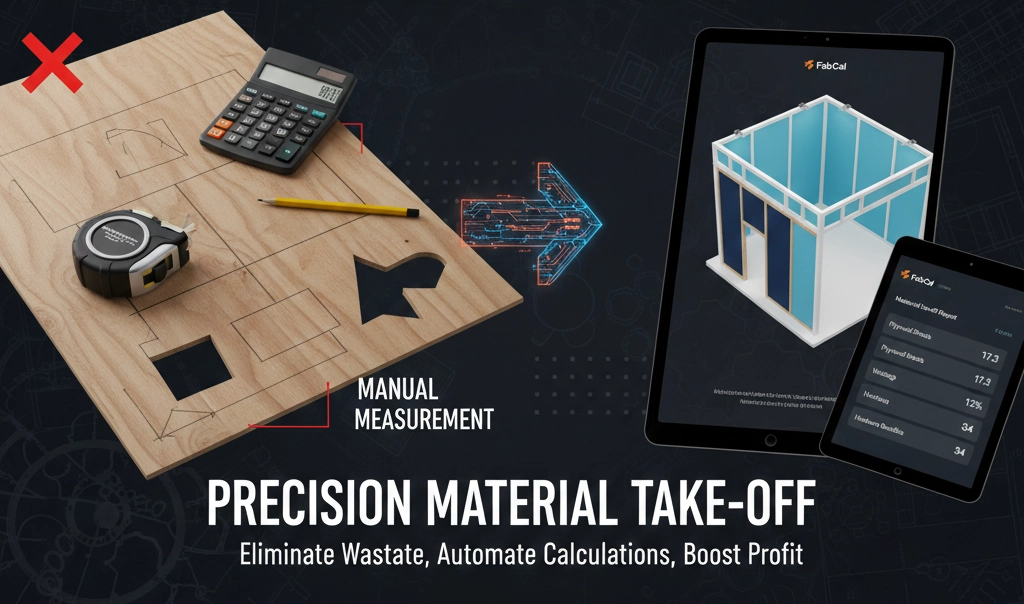
An accurate manual count is the first step, but speed requires automation. Using professional Exhibition Estimation Software allows you to instantly convert these measurements into actionable procurement lists.
Why Digital Take-off Beats Manual Entry
Manual spreadsheets lack the built-in intelligence to catch errors. A digital Exhibition Material Take-off uses verified formulas that have been tested across thousands of stalls. This ensures that the Stall Production Planning is grounded in reality. When you move from manual lists to a system-driven Exhibition Material Take-off, you gain the ability to generate Purchase and Production PDFs instantly, keeping your team synchronized from the office to the site.
Streamline Your Production Today
Ready to move past rough estimates? Master your next project with a professional approach to material estimation.





One Comment